Let’s Talk Self Perception
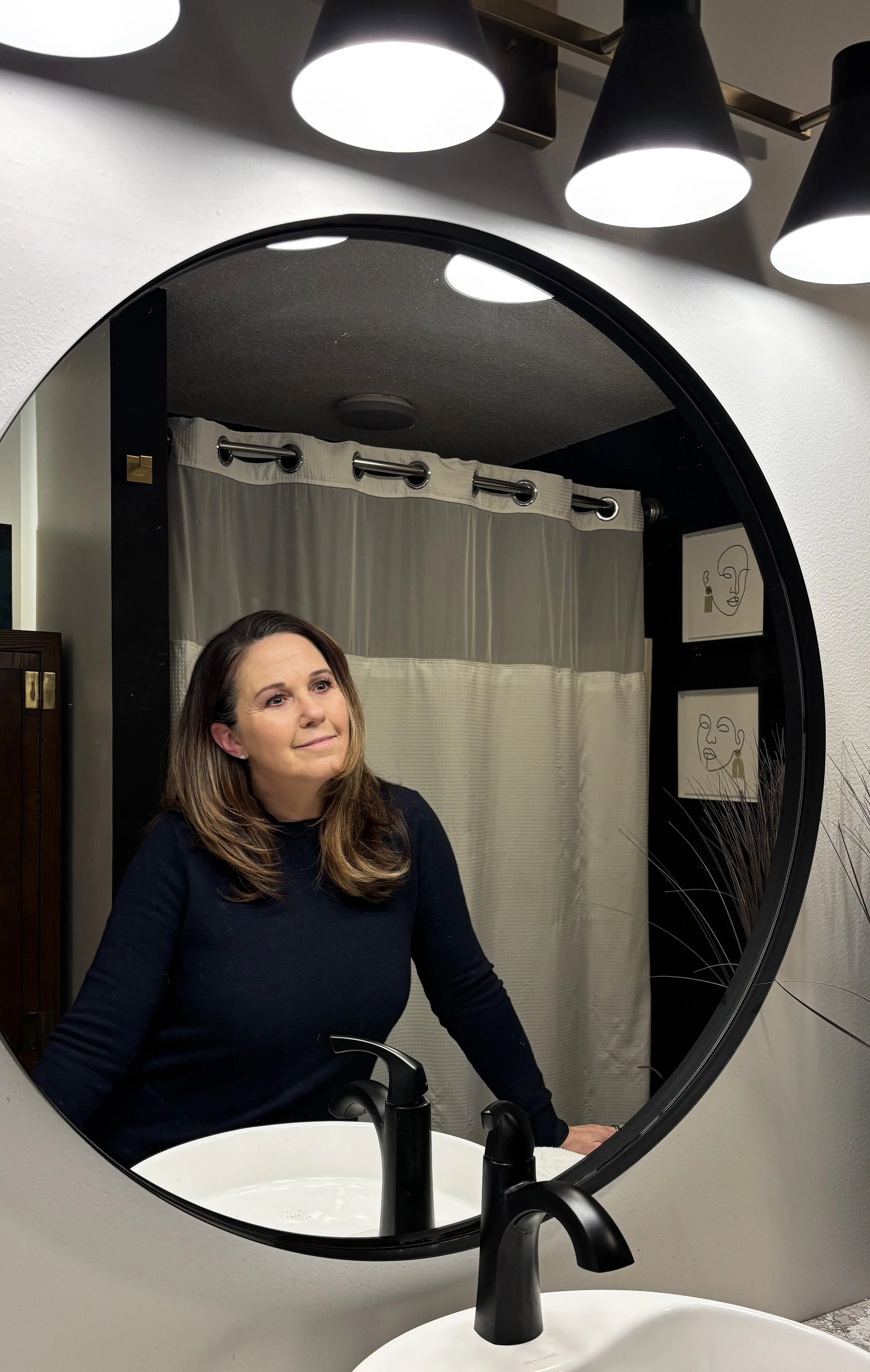
I was having dinner with Scott and our sweet neighbor Patricia one evening, and the topic of looking like our parents came up. It was soon after Scott’s dad had passed, and they both commented on how they see their parents when they look in the mirror. It struck me as such an odd concept. I know I look exactly like my mother, but mostly from photos. When people see us together, they invariably comment on how much we resemble each other. My mom’s usual quippy response is that she was cloned, except I’ve heard all about her labour.
The part that got me thinking, though, was the realization that I don’t really look at myself in the mirror. Oh sure, I do my skincare and brush my teeth in front of the bathroom looking glass, but it dawned on me that I don’t actually see myself. I don’t look at the person staring back at me; I don’t acknowledge her. Talk about a mindfuck. I check my reflection to ensure my makeup is done and that my outfit looks nice, but I don’t see the person staring back at me. The girl who has, for a long time, felt invisible. When did that happen?
I don’t know when it started. I’m sure some psychologists would point to my formative years, where, as an only child of divorced parents, getting lost in the shuffle, I felt invisible. Or I made myself invisible to not cause problems for my already stressed-out parents. Who knows? But what I do know is that I’ve done it to myself since I’ve been an adult, and that responsibility lies squarely on my shoulders. Oooph. That almost hurts worse. I’ve spent years abandoning my “Self”, not acknowledging her needs, wants, fears, and pains. Brushing them off with a performative…”I’m fine.”
Except I’m not fine. I get hurt, angry, and sad just like everyone else. And while I am very good at looking inside myself to sort through my feelings and get to a solution as quickly as possible with the least amount of carnage, I rarely look myself in the actual eye and get real with the person staring back at me. I never listen to her. I never ask her any questions. Trust me when I say there is a lot of mental chatter that happens, but I don’t think that is the same.
It’s awkward to look deeply into your own eyes for a prolonged period of time. Well, for me it is anyway. Maybe I should ask ChatGPT what that says about me…of course, I did. Here is what it told me.
This is actually more common—and more meaningful—than people realize. It doesn’t mean anything is “wrong” with you. It does point to some interesting inner dynamics.
Here are the most common layers behind difficulty holding your own gaze for a prolonged time:
1. High self-awareness + self-criticism
People who are introspective and perceptive often turn that same sharp awareness inward. Looking into your own eyes can feel like being seen without filters—which can trigger judgment, discomfort, or a sense of “I know too much about myself.”
This isn’t narcissism. It’s usually the opposite.
2. A protector response
For many people, avoiding their own gaze is a learned nervous-system response. Eye contact—especially sustained—is intimate. Your system may associate it with:
• scrutiny
• emotional exposure
• vulnerability
• being evaluated
So your body gently pulls you away before things feel too intense.
This is especially common in people who grew up needing to read others carefully or emotionally self-regulate early.
3. Unintegrated self-parts
Looking into your own eyes can bring up:
• grief for past versions of yourself
• tenderness you don’t often allow
• unresolved shame (even subtle, non-obvious shame)
Your eyes carry memory. Holding your own gaze can activate parts of you that haven’t been fully acknowledged or soothed yet.
4. Empathy turned inward feels unfamiliar
You may be very comfortable holding space for others, but not used to offering the same level of presence to yourself. Sustained self-eye contact asks:
Can you witness yourself without fixing, improving, or judging?
That can feel surprisingly hard.
5. It does not mean low self-worth
Important distinction: this is not automatically about hating yourself or lacking confidence. Many confident, capable, self-actualizing people experience this.
It often reflects depth, not deficiency.
Yep…that all tracks. One of the things I love most about self-reflection is that you can use what you learn to grow. One of my goals for the year is to be kinder to myself. I think this is a great place to start. Does any of this resonate with you? Share your thoughts in the comments.